Same price as Burp.
Everything it can't do.
Crusader is an intercept proxy, Attack Studio, mobile interception sandbox, and MCP server in one local app. Same per-seat line item as the incumbent. Built for the way you actually hunt — with mobile, with bot-defense bypass, with an agent, with your team.
- Native Frida. Android cert-pinning killed in one click.
- Browser-grade TLS. Real Chrome/JA3 fingerprint — your replays look like a browser, not a proxy.
- Identity Shadow Replay. Any request, replayed as another principal — diffed.
.js: hook + form + right-click + CLI. Hot-reload. Share as a gist.sql, hunt, llm. Your agent does real work.Not a deck.
The actual workstation.
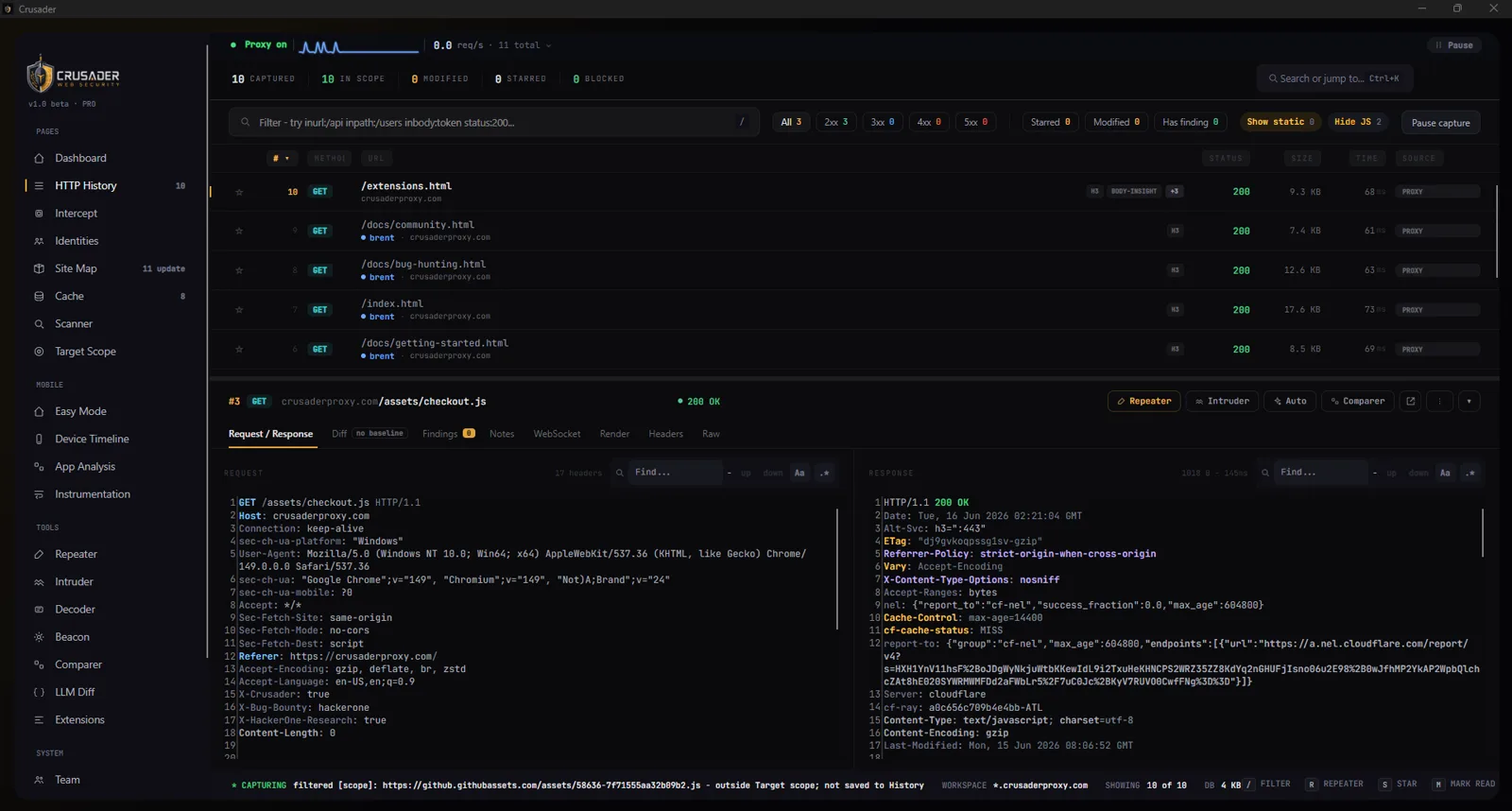
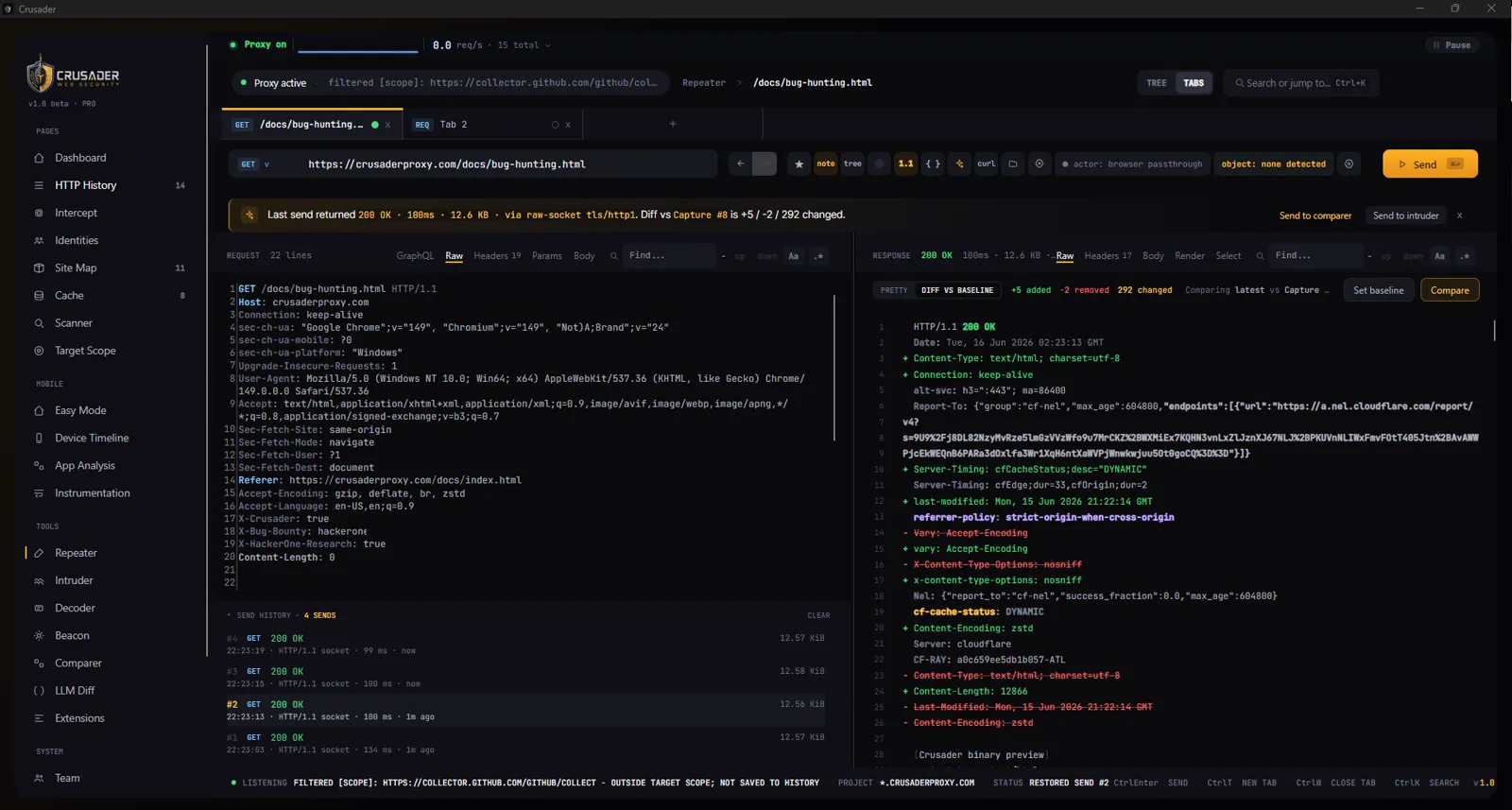
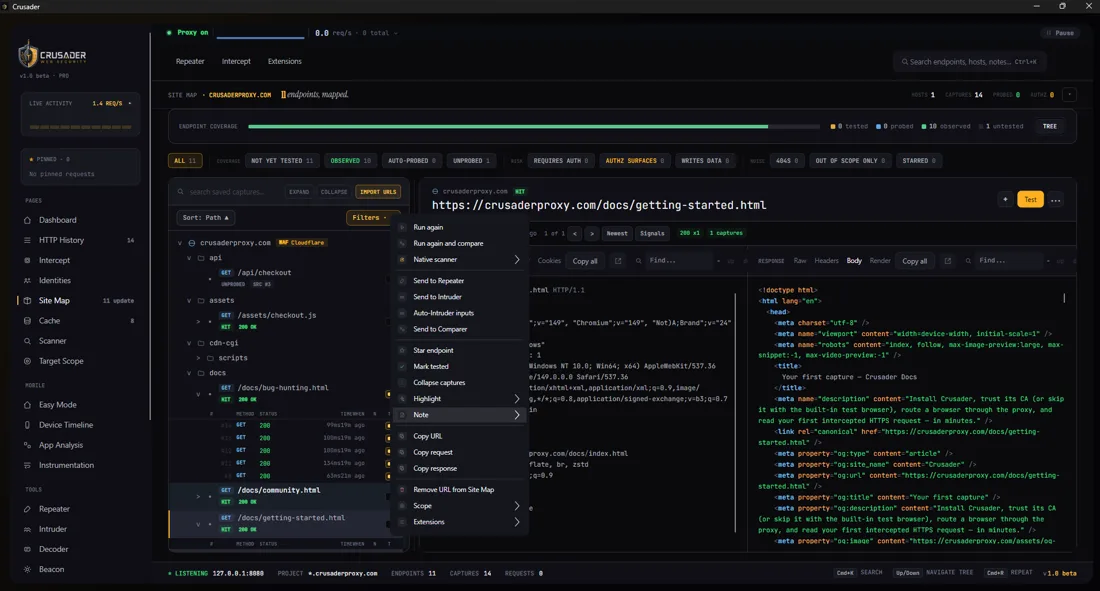
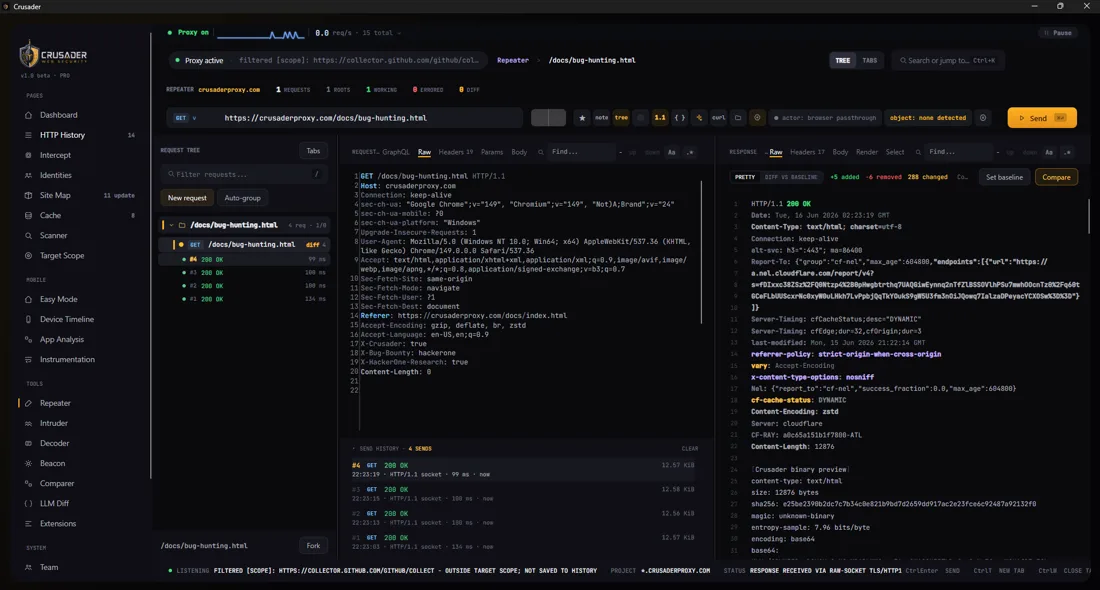
Real screens from Crusader running a live session — intercept proxy, Repeater with response diffing, a full Site Map, and analysis a stock proxy doesn't ship.
Capture → Replay →
Attack → Promote.
A whole bug-bounty session, in four moves. The same captured exchange flows from the proxy into the Repeater, into Attack Studio, into a finding — without leaving the project, without re-pasting, without three windows on top of each other.
Capture.
From any actor.
Browse through the proxy. Pipe a curl through crusader send. Hit a mobile app with Frida-killed pinning. Let your agent do it through MCP. Every capture lands in one shared history.
Replay.
Diffed automatically.
Right-click → Send to Repeater. Tweak. Send. The new response is diffed against the last — line-level inserts, deletes, token changes colored. Token placeholders mean you don't paste a bearer into a hundred requests.
Attack.
Clustered, not dumped.
One click into Attack Studio. Sweep IDs, fuzz params, brute paths. Anomalies cluster by response signature — you scan five rows instead of fifty. The outlier is the lead. Or hit crusader hunt and the agent does the whole pass.
Promote.
To finding or plugin.
The interesting capture becomes a tracked finding, a JavaScript plugin (so it runs on every future request), a CLI command (so CI catches the regression), or an MCP tool call. Same captured truth. Different actor.
Yesterday's traffic.
Today's attacks.
Drop a .burp file on Crusader's startup screen and it becomes a live workspace. Proxy history, site map, scope, scanner issues, notes all read in and re-indexed against Crusader's SQLite. Then every Crusader feature works against that captured history — diffs, Attack Studio, Frida replays, Identity Shadow Replay, plugins, agents. The switching cost is one drag-and-drop.
Eight seconds.
No email. No card.
Most security tool trials want your work email, a business justification, and a 30-minute sales call. Download, unzip, and you're hunting. 14 days of full Hunter Pro — every feature unlocked, every workflow available. Just an email to start — no card, no sales call.
The moat is architectural.
Most proxy features are surface-level — a button you didn't have, a panel you wanted. These four are foundational. Each one used to mean another tool, another script, or a workflow you didn't have time for.
Everything Burp Pro does.
Then the part it can't.
The real fear in switching proxies isn't learning a new UI — it's the one feature you rely on quietly going missing. So here's the whole checklist: every Burp Pro capability, matched line for line, before we get to the four things Burp doesn't ship at all.
Write it once.
Call it from anywhere.
Every JavaScript plugin you write is automatically a side-panel form, a right-click action, a CLI verb, and an MCP tool. Every CLI verb emits structured JSON on stdout. Every MCP call returns the same JSON, awaited. Pipe through shell. Chain through an agent. Same primitives.
Three hackers.
One workspace.
Bug-bounty crews shouldn't email project files around. Squad publishes a redacted project snapshot — findings, Repeater & Intruder tabs, identities — to a shared team endpoint, so the whole crew works from one workspace. Live presence, soft locks, and claimable tabs are rolling out during early access.
Free for the work.
Paid for the team.
Hunter Pro is $499/year — exactly what Burp Pro costs. Your AppSec budget doesn't change to switch. The free tier ships a daily-driver proxy. Squad replaces passing project files around. Founder's Edition is the cheapest seat this product will ever sell.
Free
Local proxy. HTTP/2 + WebSocket. History. Repeater (with diff). Decoder. Comparer. Unlimited JS plugins. CLI basics. Project import. Forever.
Hunter Pro
Everything in Free, unlocked. Attack Studio, Scanner, Beacon/OAST, Mobile + Frida, JA3 transport, Identity Shadow Replay, One-Button Hunt, MCP server, full CLI. Commercial use.
Squad early access
A full Hunter Pro seat for everyone + a shared team workspace. Publish findings, Repeater/Intruder tabs, and identities to one project. Live presence, soft locks & tab-claiming are rolling out in early access.
Team Pro
Squad for a whole org. SSO / SAML / SCIM, role-based access, assignment boards, a full audit trail, private extension packs, and a pooled Beacon quota across the team.
Self-Hosted Team
Team Pro on your own infrastructure. The shared workspace and Beacon run inside your network — nothing leaves your perimeter. Built for regulated and air-gapped teams.
Enterprise
Everything, plus data residency, a private extension registry, hosted AI credits, and SSO at scale — with procurement, MSA, security review, and priority support.
The questions
everyone asks first.
Do I lose my Burp work if I switch?
No. Drag a .burp file onto Crusader's startup screen and it becomes a live workspace — history, site map, scope, scanner issues, notes and highlights all import and re-index. Caido (beta), HAR, and Fiddler SAZ work the same way. Your original file stays untouched on disk.
What do I actually get for free, forever?
A real daily driver: the HTTP/2 + WebSocket proxy, history, Repeater with diff, Decoder, Comparer, unlimited JavaScript plugins, CLI basics, and project import. No account, no telemetry, no time-bomb — and it out-features Burp Community.
Mac, Windows, and Linux?
All three, natively. Crusader is built on the cross-platform Avalonia stack, so Windows, macOS, and Linux get the same features and the same single CA for every transport. Download, unzip, run.
Is my data private?
Local-first. Everything lives in a SQLite database on your machine — no account, no telemetry. Nothing leaves your box unless you turn on Team Mode (your own remote workspace) or press “Review diff,” which sends only redacted evidence to the LLM provider you configured.
Does it have a Collaborator / OAST server?
Yes — Beacon is built in. DNS, HTTP, and SMTP callbacks with geo/ASN, email alerts, and one-click promote-to-finding for blind SSRF, XXE, and out-of-band injection. No separate hosted add-on to configure — and you can run Beacon on your own server: self-hosted OAST is included on a single Hunter Pro seat, not gated behind a team or enterprise plan. (Burp's private Collaborator server is Enterprise-only.)
What happens when the 14 days end?
You drop to the free tier and keep everything you captured — history, identities, comments, and every plugin you wrote keep running. The trial never took a card, so there's nothing to cancel. Upgrade is one click whenever you're ready.
One project.
Every actor.
We're putting the final polish on the build — Windows, macOS, and Linux land together.
The 14-day Hunter Pro trial (just an email, no card) and the free-forever tier open the day downloads go live.
Founder's Edition: $249 first year — first 500 seats.